
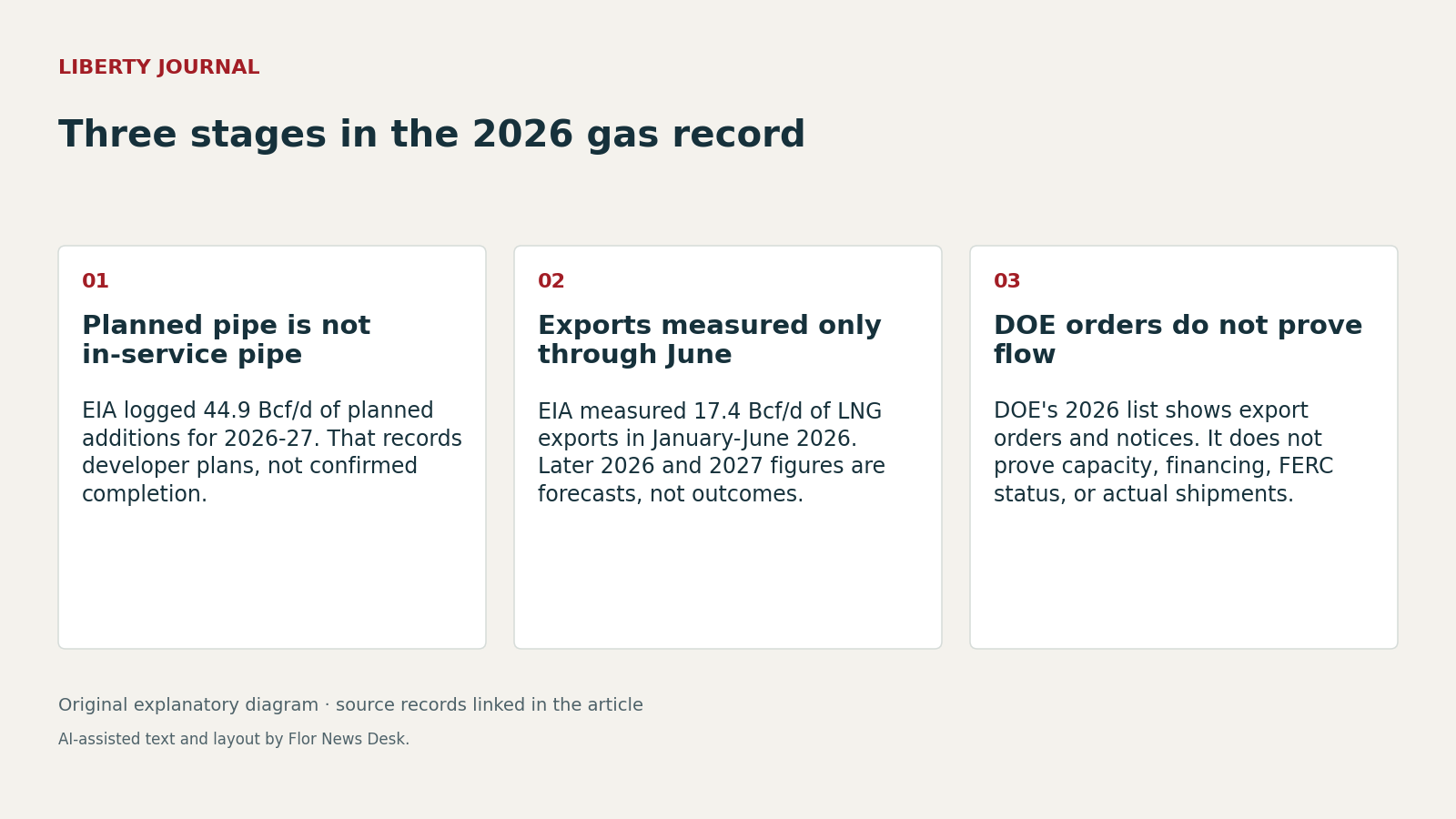
On September 1, 2026, the U.S. Energy Information Administration reported that U.S. LNG exports averaged 17.4 billion cubic feet per day in the first six months of 2026, up 23% from the same period in 2025. Read alongside EIA’s May 26, 2026 pipeline-tracker report, the federal record points to a simple conclusion: the next phase of American gas growth is not only about drilling more supply, but about moving more gas from producing regions to Gulf Coast demand and export hubs. EIA LNG exports report EIA pipeline additions report
The pipeline side of that picture is strikingly concentrated. EIA said developers planned about 44.9 Bcf/d of new U.S. natural gas pipeline capacity for 2026 and 2027, with about 31.6 Bcf/d already under construction. More than 66% of those planned additions, or 29.7 Bcf/d, originate in Texas; Louisiana was second at 8.4 Bcf/d. That matters because it suggests the commercial center of gravity remains the Gulf-linked production corridor. But the same EIA page is explicit evidence of planned additions, not proof of completion, in-service status, or actual throughput. As of October 11, 2026, some milestones described there in future tense, including a third-quarter 2026 expectation for Blackcomb, are already partly or wholly past, and that May record does not establish what happened next. EIA pipeline additions report
The export record shows why those transportation links matter. EIA said Plaquemines LNG was exporting at full capacity and Corpus Christi Stage 3 was exporting from six of seven liquefaction trains; when complete, those two terminals would raise nominal U.S. LNG export capacity by a combined 4.0 Bcf/d. EIA also said Golden Pass LNG began exports in April 2026 and shipped less than 0.2 Bcf/d from April through June. Exports to Asia rose by 2.3 Bcf/d, while exports to Europe rose by 0.1 Bcf/d in the first half of 2026. For a conservative reader, the economic implication is straightforward analysis: where private capital adds liquefaction and transportation, U.S. gas can reach more buyers at home and abroad. The limit is equally important: EIA’s second-half 2026 and first-half 2027 figures are estimates, not realized outcomes. EIA LNG exports report
DOE’s Hydrocarbons and Geothermal Energy Office adds another layer, but not the final one. Its October 8, 2026 index lists 2026 natural-gas and LNG authorizations, orders, and notices, including a February 26 long-term authorization for Corpus Christi-related entities to export LNG to Non-Free Trade Agreement Nations, a March 26 rehearing denial involving Venture Global CP2 LNG, a May 6 long-term authorization for Venture Global Plaquemines Expansion to Free Trade Agreement Nations, and an April 17 Mexico Pacific notice withdrawing a draft environmental assessment and terminating that assessment process. Those entries show DOE continued processing export-related matters in 2026. They do not, by themselves, prove capacity, financing, construction progress, FERC status, startup, or cargo volumes. DOE 2026 authorizations index
That distinction matters for policy. Free-enterprise arguments for faster permitting gain force when federal data show both export demand and a large Texas-centered queue of proposed takeaway capacity. Yet the public record here does not prove that every authorization becomes steel in the ground, or that every planned line reaches service on schedule. It also does not establish a measured household-price effect from these particular projects. What it does establish is narrower and still important: by mid-2026, American LNG exports were materially higher, and federal records still showed heavy planned pipeline buildout aimed at the same broader Gulf Coast gas system. EIA LNG exports report EIA pipeline additions report
For Liberty Journal readers, the practical dividing line is paper versus performance. EIA has documented stronger export volumes and a large backlog of planned pipeline additions, especially from Texas. DOE has documented continuing administrative action on export matters. What these records do not establish, as of October 11, 2026, is which specific pipeline milestones or export-project steps have already crossed from authorization or expectation into fully realized operating capacity. EIA pipeline additions report DOE 2026 authorizations index