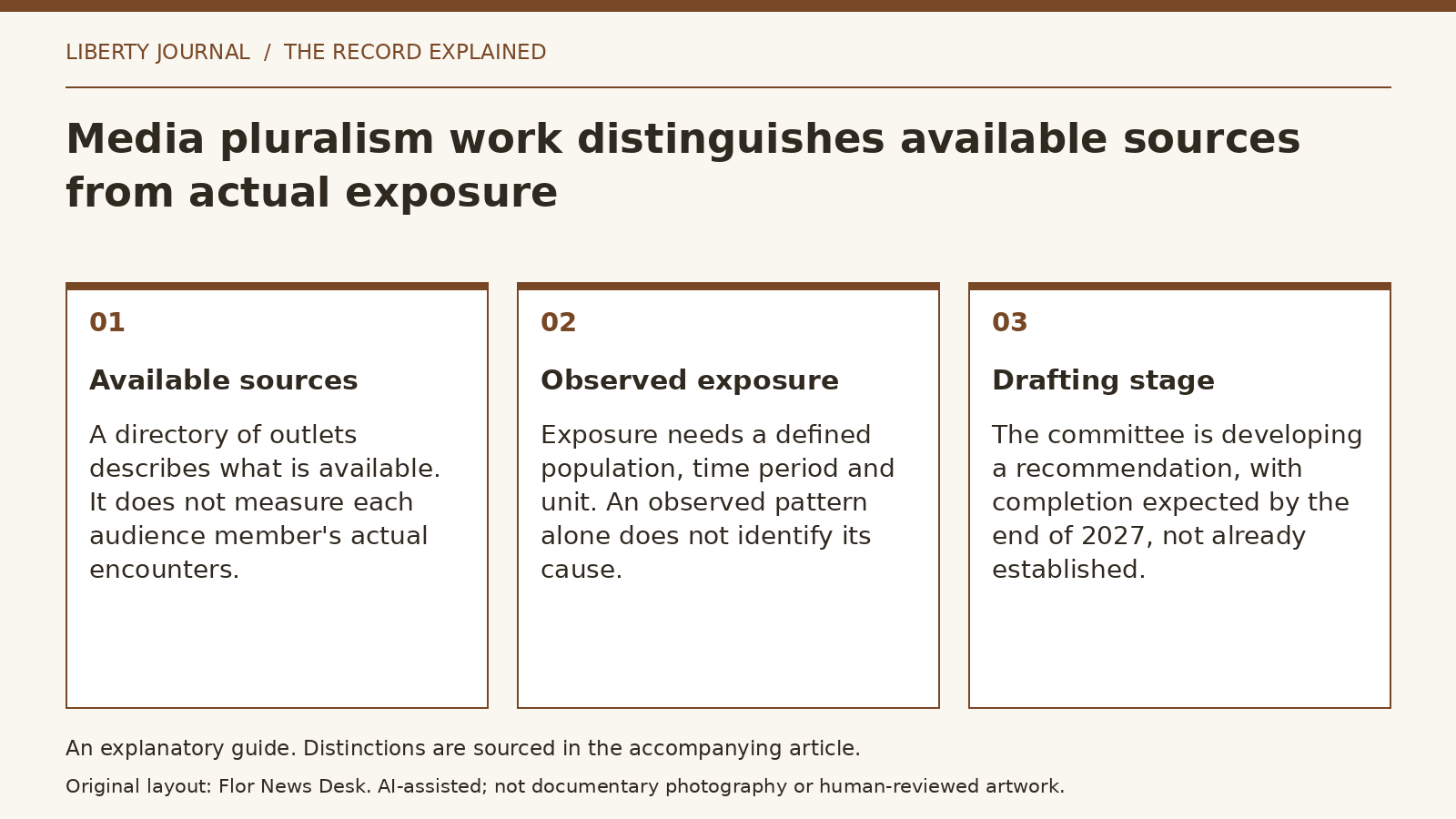

Council of Europe experts met on September 8 and 9, 2026 to continue work on a recommendation concerning media pluralism in the digital environment. The institution's September meeting account describes attention to what audiences encounter, alongside the availability of different media sources. It reports drafting work, not the adoption of a new binding rule.
The distinction is a measurement problem before it is a conclusion about any particular media system. A catalogue can establish that several sources are available. An observation of an audience's actual encounters would answer a different question. A larger catalogue does not, without additional evidence, show that people encounter a wider range of sources.
A hypothetical reading service makes the difference concrete. Suppose its directory lists twenty outlets, while an individual reader encounters material from three during a specified week. The numbers describe different units: listed sources and sources encountered by that reader in that period. Neither observation can be substituted for the other. These figures are illustrative, not measurements of a real platform.
Nor would the second number alone explain the cause of that pattern. A reader's choices, a service's presentation and other circumstances could require separate examination. Observing a narrow or broad set of encounters would not by itself identify which mechanism produced it. A causal claim needs evidence beyond the outcome being described.
A recommendation still being developed
The Council of Europe's account of the committee's first meeting dates that meeting to March 3 and 4, 2026. It describes representatives of member states and independent experts working under the Steering Committee on Media and Information Society, with preparation of a Committee of Ministers recommendation as their task. The work is expected to be completed by the end of 2027.
That timetable is an expectation in the institutional record, not evidence that a final text already exists or a guarantee of completion. The September meeting is a later stage in the same work programme. Counting the two meetings as two adopted measures would confuse activity with an agreed output.
The availability and exposure distinction also raises questions about aggregation. In the hypothetical service, one reader's week cannot establish the experience of every reader. A network-wide total cannot describe each person's experience either. Moving between those levels would require information about how observations were gathered and combined.
An encounter itself can also be defined at different levels. A source being offered on a screen is not logically identical to an article being opened or read. Any future measurement would need to identify its unit before readers could compare results. This is an analytical observation about measurement, not a claim that the committee has chosen a particular operational definition.
The two linked pages are Council of Europe accounts of its own expert process. They do not provide independent audience measurements, establish conditions in every member state or rank political viewpoints. They also do not settle the content of the eventual recommendation.
For following the work, three records remain distinct: evidence about what exists, evidence about what audiences encounter and the text of any recommendation ultimately adopted. The September update concerns the development of that last instrument. It does not supply all three kinds of evidence at once.