
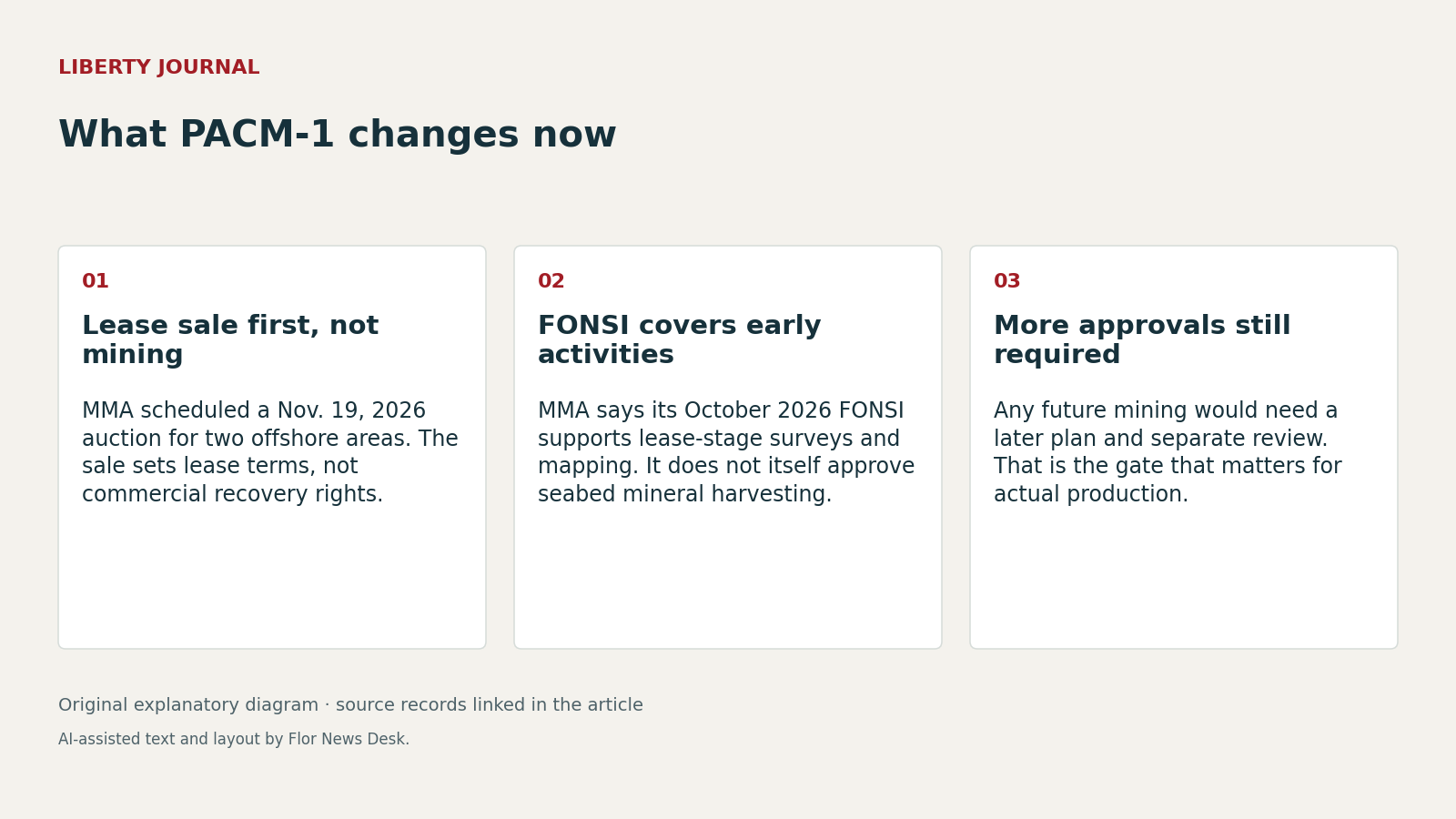
The Department of the Interior’s Marine Minerals Administration took a concrete step on October 19, 2026, when it announced a Final Leasing Notice for Lease Sale PACM-1 offshore American Samoa and set the auction for November 19, 2026. The notice would offer two offshore areas for lease, making this more than a policy speech. But the same federal record also draws an important limit: a lease sale is not the same thing as approval to mine the seabed. (MMA press release, American Samoa Activities)
That distinction matters for readers who care about domestic supply chains and strategic resources. According to MMA, the Final Leasing Notice sets the lease areas, sale schedule, lease terms and stipulations, rental and royalty rates, and bidder information. MMA also says a winning bid and lease would allow preliminary work such as mapping, while a separate post-auction process would still be required before physical exploration, testing, or commercial harvesting could begin. In practical terms, the October action opens a federal pathway for offshore critical-minerals development; it does not yet establish mineral output, export volumes, royalties, or commercial recovery. (MMA press release)
The environmental record described on MMA’s American Samoa page is similarly narrow. MMA says it completed a National Environmental Policy Act environmental assessment for proposed commercial leases offshore American Samoa and issued a Finding of No Significant Impact in October 2026. The same page defines preliminary activities as surveys and other actions that do not significantly harm Outer Continental Shelf natural resources and only allow a leaseholder to characterize the environment. Read together, those statements support a limited conclusion: the October FONSI addresses lease-stage and characterization activity, not a future commercial mining operation in full. (American Samoa Activities)
MMA’s own chronology reinforces that limit. In its July 16, 2026 entry, the American Samoa page says any future mining would require submission and approval of a Delineation, Testing, and/or Mining Plan, and that those later steps would face separate environmental review. That is the critical checkpoint for free-enterprise advocates and skeptics alike. A competitive lease auction can signal investor interest and federal willingness to open acreage, but the legally material question for actual production remains whether a lessee later advances a plan that regulators approve. (American Samoa Activities)
The administrative backdrop is also worth separating from outcomes. Interior’s transition page says the department is reunifying the Bureau of Ocean Energy Management and the Bureau of Safety and Environmental Enforcement into the Marine Minerals Administration under Secretarial Order 3451, with the stated aim of improving coordination, reducing duplication, and preserving existing protections during the transition. The October 19 sale announcement says that reunification had occurred as of July 10, 2026. That may matter over time because offshore resource development often turns on whether leasing, safety, and environmental oversight are aligned. What the cited pages do not establish, however, is that the new structure has already sped approvals, changed safeguards, or delivered measurable economic gains. (Transition to the Marine Minerals Administration, MMA press release)
So PACM-1 is best understood as a strategic opening move, not a production milestone. For a publication focused on U.S. prosperity and supply security, that is still significant: Washington is moving from broad critical-minerals talk to a scheduled offshore lease auction. But the next evidence readers should demand is concrete and sequential: whether bids are actually received on November 19, whether leases are executed, and whether any later delineation, testing, or mining plan survives its separate review. Until those steps occur, the federal record supports optimism about optionality, not claims of new American mineral supply. (MMA press release, American Samoa Activities)