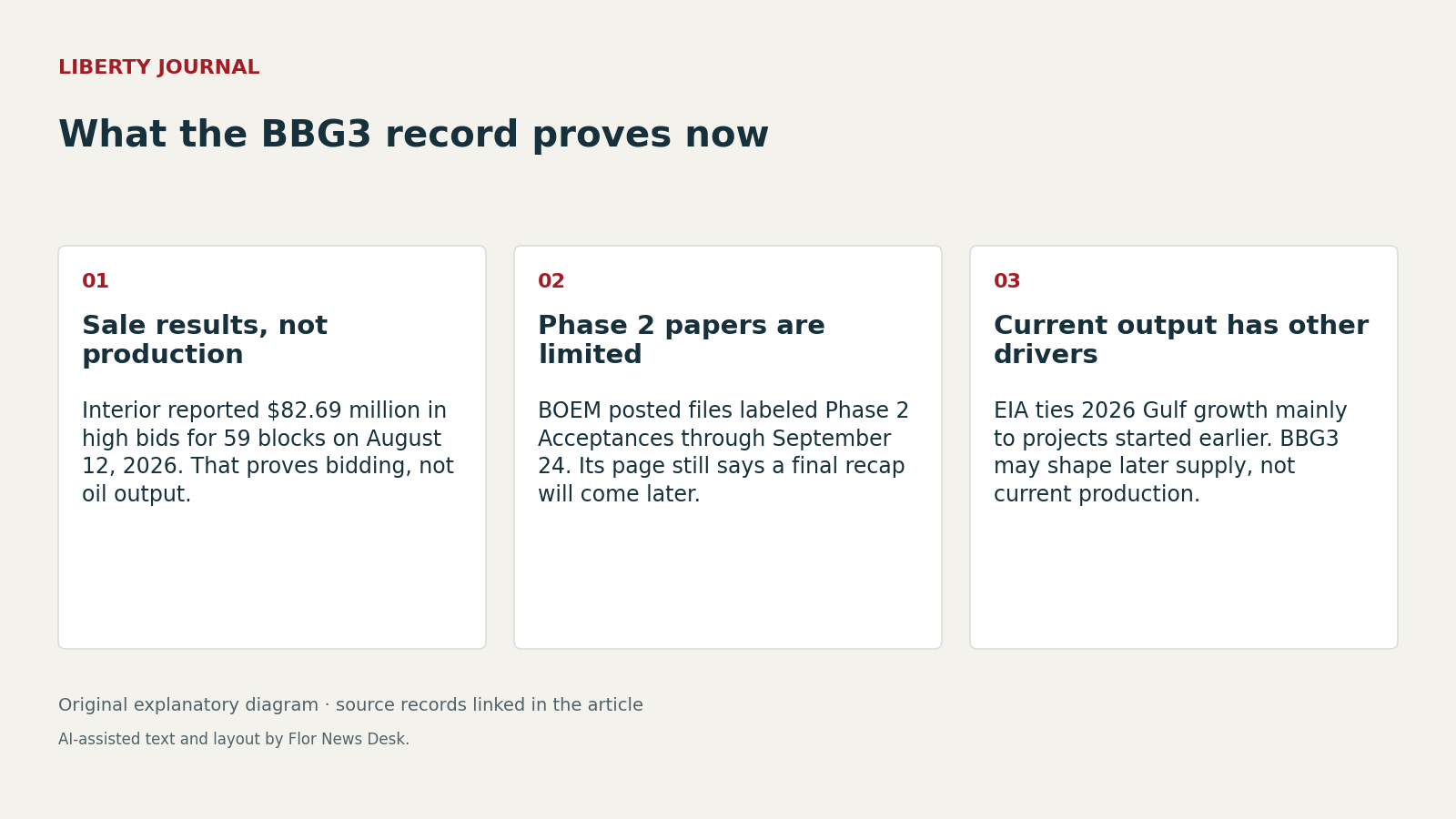
BOEM’s Big Beautiful Gulf 3 sale page now carries documents labeled “Phase 2 Acceptances” dated September 11, September 17 and September 24, 2026, extending the paper trail for the offshore auction held on August 12, 2026 BOEM BBG3 sale page. Interior said that sale generated $82,689,756 in high bids for 59 blocks across about 330,150 acres in federal waters of the Gulf of America DOI press release. For energy policy readers, that is a concrete sign that companies are still willing to commit capital to federal offshore acreage. It is not yet proof of new production, new jobs totals or new federal revenue actually received.
The strongest verified point is narrower and still important: the Gulf leasing machine is moving. According to Interior, 16 companies submitted 69 bids totaling $99,476,285, and the Final Notice of Sale had been published in the Federal Register on July 8, 2026 DOI press release. Because there were more bids than high-bid blocks, at least some tracts attracted competing offers. That supports a free-enterprise reading of the result. Offshore developers did not merely show up for a ceremonial sale; some were willing to bid against each other for positions they think could matter later.
But the public record also imposes real limits. The BOEM sale hub says a final bid recap with acceptance and rejection results will be posted about three months after sale day, which means the adjudication record was still incomplete as of September 29, 2026 BOEM BBG3 sale page. The retrieved BOEM text does not define “Phase 2 Acceptances,” identify in that page text which bids were accepted, or show executed leases, bonus payments received, permits, drilling or production BOEM BBG3 sale page. Interior also described a 12.5% royalty rate for the blocks DOI press release, so the sale points toward possible future federal income if leases are ultimately issued and developed. The retrieved records do not show any royalty collections.
That distinction matters because current U.S. output strength is coming from earlier investments, not from BBG3. EIA said on September 10, 2026 that U.S. crude production is on track to average a record 13.8 million barrels per day in 2026, with much of the expansion concentrated in the Permian region and the Federal Gulf of America EIA Today in Energy. EIA said Federal Gulf output in the first half of 2026 was up 10% from a year earlier and attributed that increase primarily to four projects that came online in 2025, while also expecting four smaller projects by the end of 2026 EIA Today in Energy. The analytical takeaway is that BBG3 is better understood as replenishing the future project queue than as explaining current record production.
BOEM’s broader leasing schedule reinforces that point. The agency’s lease-sales page lists BBG4 for March 2027 and BBG5 for August 2027, and it presents BBG1 through BBG30 as part of a longer 2025-2040 schedule labeled “OBBBA Sales,” defined there as the One Big Beautiful Bill Act BOEM lease-sales schedule. That schedule is evidence of planned cadence, not proof that every sale will occur on time or produce similar results. The retrieved records also contain a naming discrepancy: BOEM uses One Big Beautiful Bill Act language while the DOI press release refers to a Working Families Tax Cut Act BOEM lease-sales schedule DOI press release. The core policy case for domestic energy remains intact without overstating the paperwork. September’s posting shows momentum for offshore leasing; it does not yet establish the downstream economic outcome.