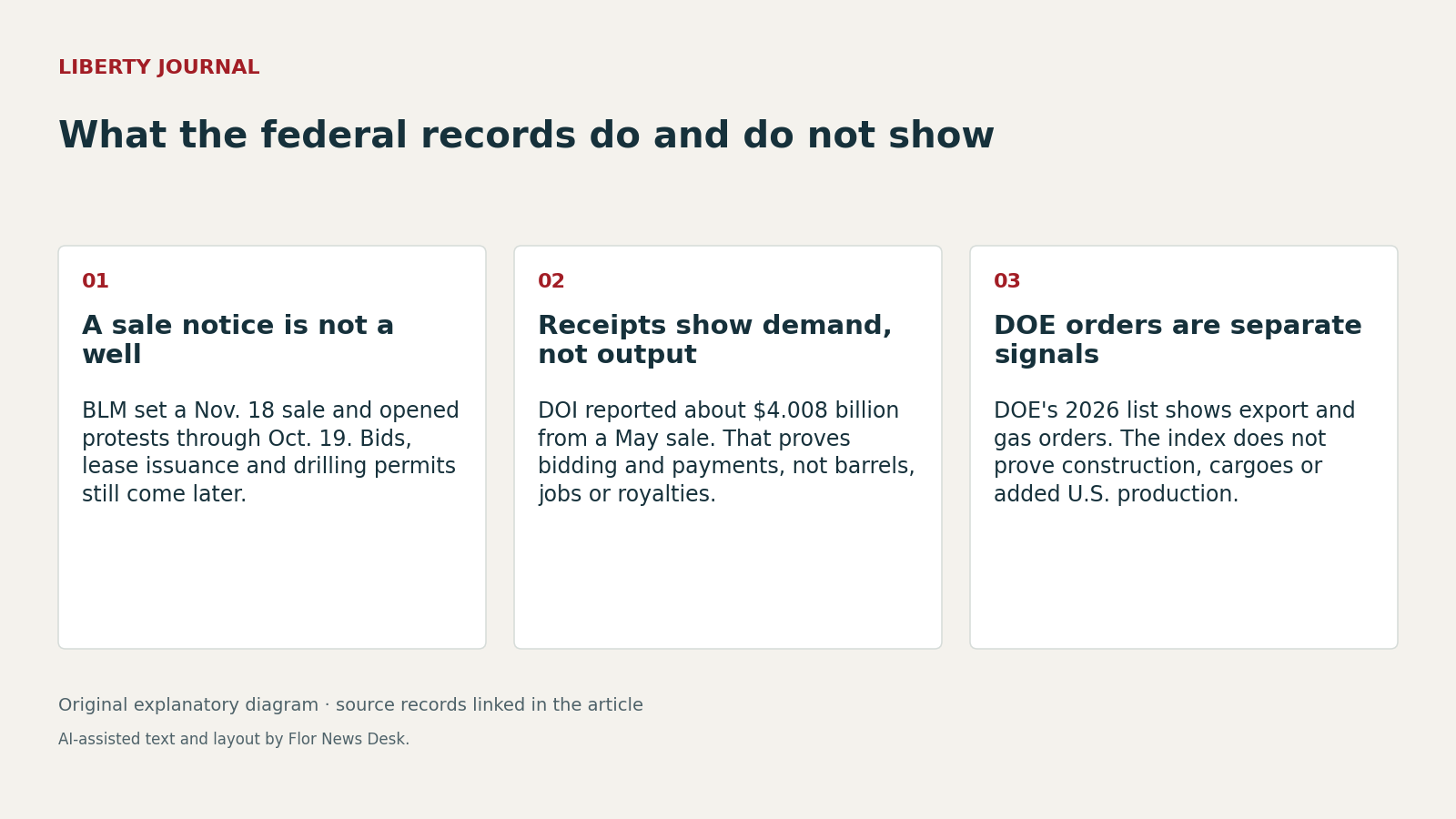
The Bureau of Land Management took a concrete onshore leasing step on Sep. 18, 2026, when it scheduled a Nov. 18, 2026 oil-and-gas lease sale covering 30 parcels and 8,071 acres in New Mexico, Oklahoma, Texas and Kansas. BLM also said scoping on those parcels was completed in June 2026, the public comment period closed in August 2026, and a 30-day protest period runs through Oct. 19, 2026. As of the current date, Oct. 12, 2026, that record proves a live federal leasing process, not a completed sale or a producing well. BLM’s own notice says leasing is only the first step and later drilling would still require an application for permit to drill. BLM sale announcement
Why the notice matters is clear from another federal record: the Department of the Interior said on May 20, 2026 that a BLM lease sale in New Mexico and Texas leased 74 parcels totaling 33,530 acres and generated about $4,007,944,870 in combined bonus bids and rental payments. BLM’s broader oil-and-gas program page separately lists the same May 20 New Mexico sale total, plus another New Mexico sale on Aug. 19, 2026 at $139,021,741 and a Wyoming sale on Sep. 9-10, 2026 at $82,404,165. That page defines total receipts as rents, bonuses and administrative fees from competitive lease sales. Taken together, those records support a narrow but important conclusion: companies have recently committed very large sums for federal onshore acreage. DOI May 20 release BLM oil and gas page
For a publication focused on growth and energy security, that is a meaningful market signal. Upfront bidding shows private firms see value in getting access to acreage under current price and policy expectations. Interior also said the May 20 sale was conducted under the Working Families Tax Cuts Act and that the law lowered the federal royalty rate for new onshore production to 12.5% from the 16.67% rate set under the Inflation Reduction Act. A lower royalty rate can strengthen the investment case. But the same record limits what can be claimed: receipts are not the same thing as later production, royalty collections, tax revenue or payrolls. DOI May 20 release
The demand-side case is reinforced, though not completed, by the Department of Energy’s Oct. 8, 2026 index of authorizations, orders and notices issued in 2026. That listing includes a Feb. 26 long-term non-free-trade-agreement LNG export authorization for Corpus Christi entities, a Mar. 26 order denying rehearing in the Venture Global CP2 LNG docket, an Aug. 12 free-trade-agreement LNG authorization for Corpus Christi Stage IV entities, and multiple Oct. 7 blanket natural-gas import and export orders. Those entries show continuing federal action on gas trade and LNG market access. They do not prove construction progress, cargoes shipped or added U.S. production, because the page is only an index. DOE 2026 authorizations list
BLM’s own program structure helps explain the gap between headlines and measurable output. The agency separates Leasing from Exploration, Operations and Production, Inspection and Enforcement, and Reclamation. That matters because a lease notice, a high-bid total and an LNG export order each sit at different points in the chain. Interior’s May 13, 2025 policy announcement aimed to shorten lease-parcel review to roughly six months from scoping to sale and said the prior review window had often run eight to 15 months. The Nov. 18, 2026 sale notice may fit that faster timetable, but the 2025 document was a policy announcement, not an audit proving systemwide results. BLM oil and gas page DOI 2025 policy release
The practical takeaway is disciplined rather than gloomy. By Oct. 12, 2026, the federal record supports saying onshore leasing is active and drawing serious capital. It does not yet support saying the Nov. 18 sale succeeded, that new wells are coming quickly, or that LNG-related orders have translated into higher export volumes or domestic output. The next proof points are later sale results, any lease issuances, subsequent drilling-permit filings, and later production and royalty data. Until those appear, the strongest verified claim is that Washington has reopened a meaningful onshore leasing lane, while the economic payoff still has to be earned in later records. BLM sale announcement BLM oil and gas page