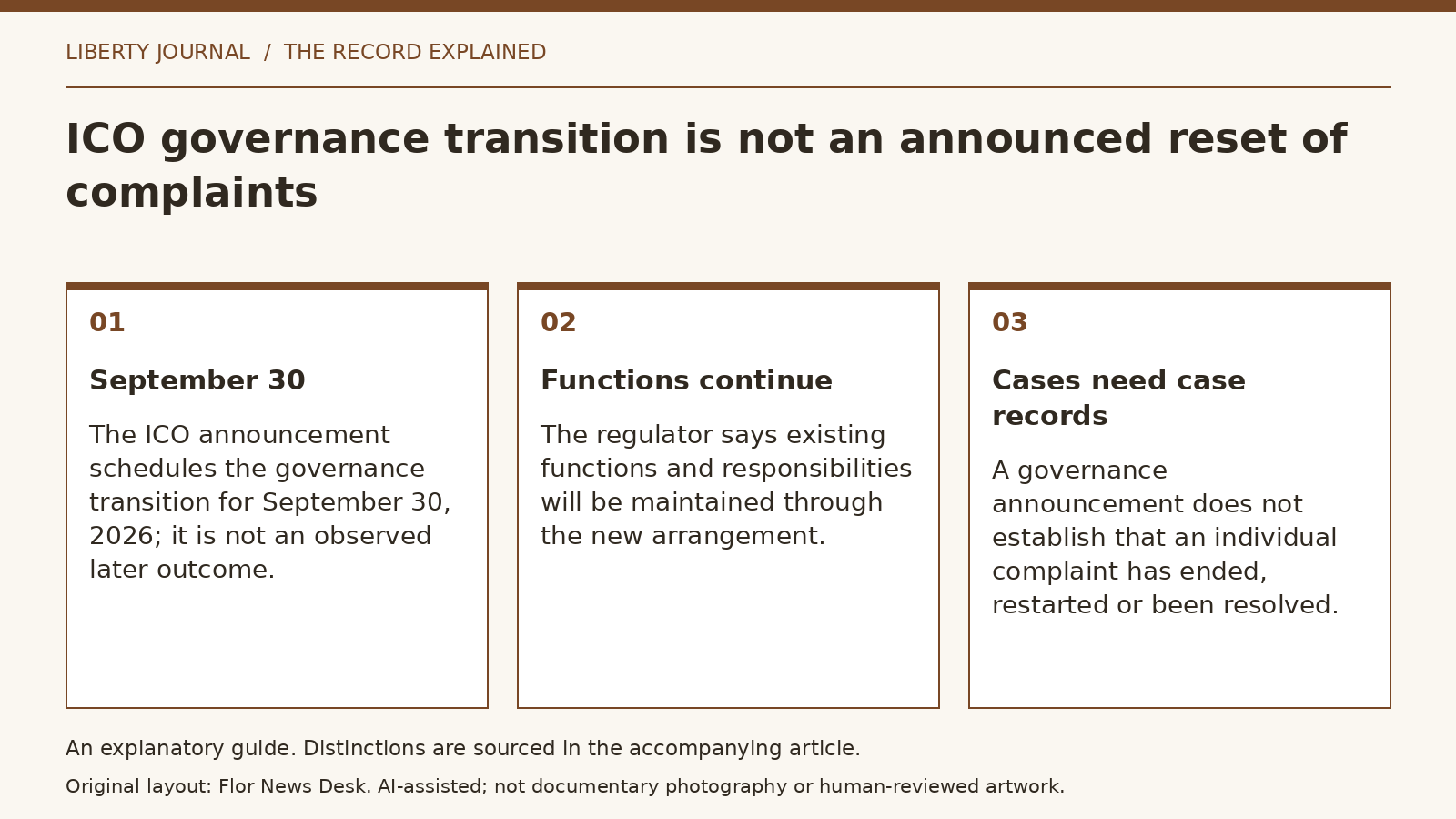

The UK's Information Commissioner's Office has announced September 30, 2026 as the date for its transition to the Information Commission. Its September announcement, updated September 17, says the change concerns governance under the Data (Use and Access) Act 2025 and that existing regulatory functions and responsibilities will be maintained. September 30 remains a future date in the records examined for this report.
The distinction matters to an organization or individual following an existing regulatory matter. A change in the structure governing a regulator is not, without further evidence, a cancellation of its files or a replacement of every procedure it administers. The announcement does not tell complainants that their matters have been erased or that they must start again.
It also says the organization will continue to be known as the ICO. That separates a familiar public name from the legal and governance transition. Seeing the same initials after the announced date would not show that no structural change occurred; seeing a new formal name would not, by itself, establish a break in the handling of a particular matter.
Three different observations
A fictional complainant illustrates the evidentiary problem. Suppose someone submitted a complaint before a regulator's governance transition. A news announcement could identify the transition date. A receipt could establish that the complaint was received. A later case communication could describe what happened to that complaint. None of those records can perform all three jobs simply because they concern the same institution.
The example is not a prediction of how any ICO complaint will proceed. It explains why a governance announcement should not be used to infer an individual case outcome, whether favourable or unfavourable. The relevant case record would still be needed.
The September notice follows the July 15 announcement of seven non-executive board appointments. That earlier record describes preparation for the new governance arrangement. An appointment announcement establishes an appointment at the stated time; it does not measure the board's subsequent performance or establish the completion of every later transition task.
The chronology therefore contains preparation and a scheduled change, not an observed post-transition outcome. An August recruitment deadline mentioned in the July material is also a historical deadline by September. It would be inaccurate to present that recruitment window as currently open merely because the earlier notice remains accessible.
Service continuity is another claim requiring careful timing. The regulator's stated intention to maintain functions describes the transition it has announced. Evidence about actual response times, case handling or service interruptions after September 30 would have to come from later operational records. No such future performance is established here.
Both source documents are the ICO's own announcements. They are useful for identifying what the organization says will change and what it says will continue, but they are not independent assessments of execution.
For now, the documented position is a scheduled governance transition with continuing regulatory responsibilities. It is neither proof that all implementation work has already finished nor an announced general reset of complaints. Keeping those claims separate avoids turning an institutional date into an unsupported conclusion about an individual file.