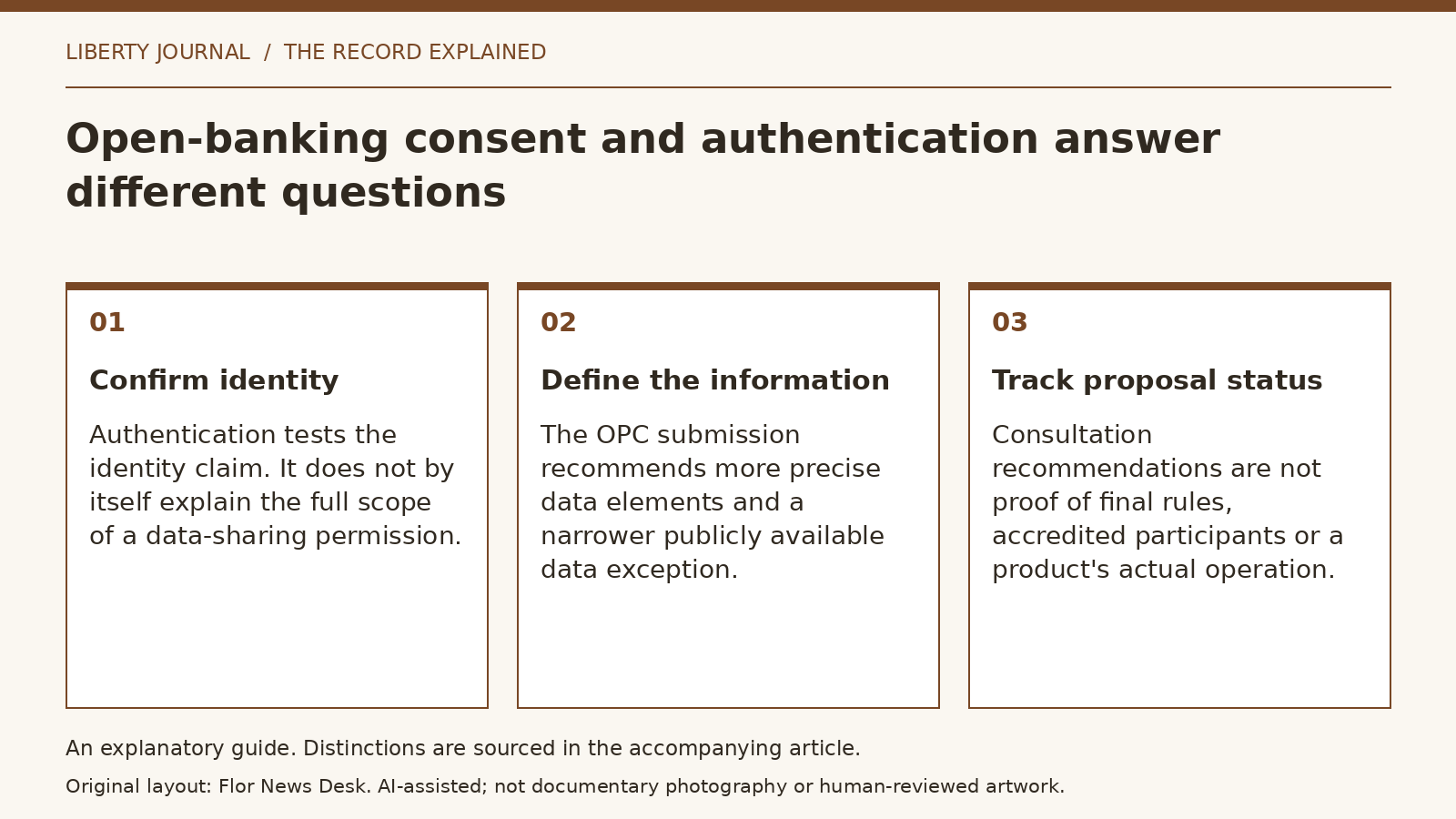

The Office of the Privacy Commissioner of Canada published comments on proposed consumer-driven banking regulations on August 26, 2026. Its announcement identifies several measures it supports, including multi-factor authentication, while recommending changes concerning the information covered and its use. This is a regulatory submission on proposals, not evidence that every recommendation has become a final rule.
The comments expose a distinction that a smooth sign-in process can conceal. Authentication asks whether the requester is the person or entity they claim to be. An explanation of data sharing asks what information will move, to whom and for which activity. Establishing identity does not, by itself, describe the scope of a permission.
For example, imagine a fictional budgeting service with a successful multi-factor sign-in. The user is then shown a permission labelled account information. A technical record could demonstrate that the sign-in succeeded without establishing whether the user understood that label to include past transactions. This example makes no assertion about a real banking service; it separates two questions that would need different evidence.
The meaning of a data category
In its detailed submission, the OPC argues that the proposed data categories do not identify the covered elements with enough specificity. It recommends more detail and proposes narrowing an exception for publicly available data. It also recommends an overarching safeguards requirement appropriate to the information's sensitivity, alongside specified security measures. These are the office's recommendations, not findings that a named participant misused data.
A broad category and a specific field serve different explanatory functions. In the fictional service, one category might contain several fields. Describing the category could tell a reader the general subject without telling them which fields are included. Listing fields could resolve that uncertainty but still leave the purpose or duration of use unclear. More detail in one part of a description does not automatically fill every other gap.
The same reasoning distinguishes access security from later handling. A login can be protected while the permitted destination or use remains a separate issue to assess. Conversely, a clearly described purpose does not establish that the transfer is technically secure. Treating either control as a complete account would remove an evidentiary step rather than answer it.
The OPC's announcement also discusses proposed reporting of security breaches to the Bank of Canada. A reporting mechanism concerns what follows an incident; it is not a substitute for explaining the information flow before it begins. Identity checking, permission scope, protection and incident reporting therefore occupy different points in the proposed system.
There are limits to drawing conclusions from a consultation response. The cited records provide the OPC's view of the proposals at that stage. They do not establish the final regulatory text, participant accreditation, the operation of a particular product or the experience of any customer. Both come from the same institution.
For a reader following the next stage, the question is what the eventual instrument actually says about each control. An announcement that strengthens one mechanism would not, without more evidence, show that every other question had been resolved. The August submission is a map of distinctions to examine, not an implementation certificate.