
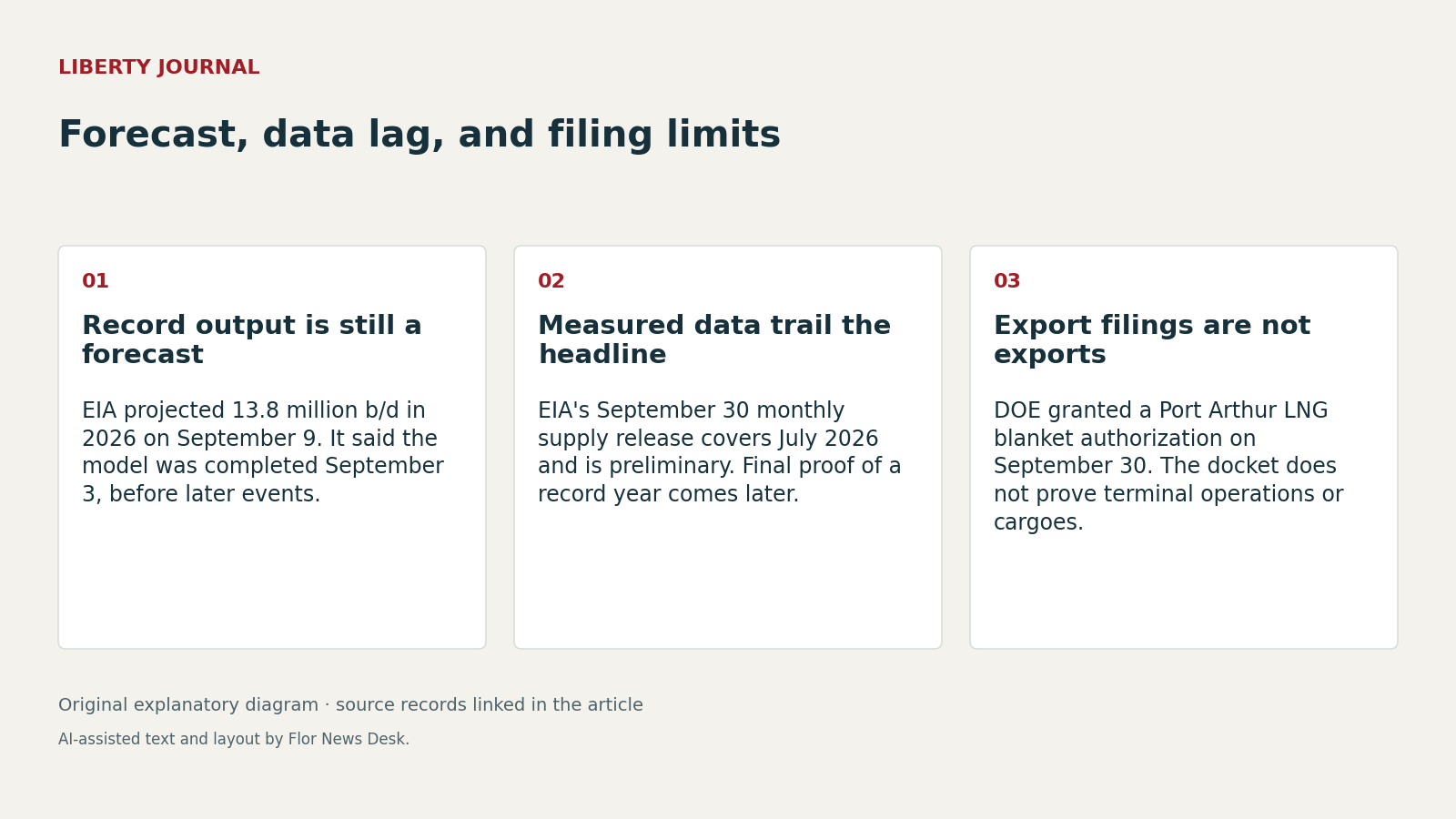
On September 9, 2026, the U.S. Energy Information Administration projected that U.S. crude oil production would average 13.8 million barrels per day in 2026, above 13.7 million in 2025, with 14.3 million projected for 2027. EIA also states that this Short-Term Energy Outlook was completed on September 3 and does not specifically account for events after that date. That matters: the headline is a federal forecast, not a final production tally. EIA Short-Term Energy Outlook
The strongest support for that forecast is not a sudden national surge but continued output from a few heavyweight regions. In a September 10 analysis, EIA said U.S. crude production averaged 13.7 million barrels per day in the first half of 2026, up 0.3 million from the first half of 2025, and attributed most projected growth to the Permian region in Texas and New Mexico and the Federal Gulf of America. EIA forecast Permian production at 6.8 million barrels per day in 2026 and said Gulf output was expected to rise as smaller projects came online, while also cautioning that hurricanes could affect timing. The practical reading is that the record call depends on sustained basin performance, not a broad-based boom everywhere. EIA Today in Energy
Readers should also separate forecast confidence from measured confirmation. EIA’s Petroleum Supply Monthly page shows that the September 30, 2026 release contains July 2026 data and describes those figures as preliminary, with the next release due October 30. So even after the September forecast, the monthly federal production record still lags by several months. That is a meaningful limit for anyone claiming that the record year is already settled fact. Petroleum Supply Monthly
The more important market warning in the same forecast is downstream, not upstream. EIA projected U.S. distillate fuel oil inventories would fall below 100 million barrels in September 2026 and remain below the 2021-2025 five-year low through much of 2027. It also raised its 2026 retail diesel price forecast to $5.07 per gallon from $4.85. Even if crude output sets a record, EIA’s own outlook says that does not automatically translate into comfortable product inventories or lower diesel costs. For a pro-growth energy argument, that distinction is central: more supply still helps, but crude abundance and refined-fuel tightness can exist at the same time. EIA Short-Term Energy Outlook
Natural gas and LNG filings point in the same broad direction on investment incentives, but they do not prove new physical capacity is already working. EIA forecast LNG exports at 17.4 billion cubic feet per day in 2026, up from 15.1 in 2025. Separately, the Department of Energy page for Port Arthur LNG says the company sought blanket authorization on May 5, 2026 to export previously imported LNG up to the equivalent of 20 billion cubic feet over two years, and the docket page lists a September 30 order granting that authorization while describing the terminal as under construction. That is an administrative step, not proof that the terminal is operating or shipping cargoes. EIA Short-Term Energy Outlook DOE Port Arthur LNG docket
Taken together, the federal record supports a conservative pro-supply conclusion, but a disciplined one. The documents strengthen the case for stable permitting and infrastructure development because EIA still sees rising oil and LNG volumes ahead. At the same time, the same documents do not establish finished 2026 production, actual late-September distillate levels, terminal startup, export cargoes, or any quantified job gain. What they do establish is narrower and still consequential: Washington’s own energy agencies are signaling strong U.S. hydrocarbon output potential alongside a real risk that diesel markets stay tight enough to burden consumers even in a record-oil year. EIA Short-Term Energy Outlook Petroleum Supply Monthly