
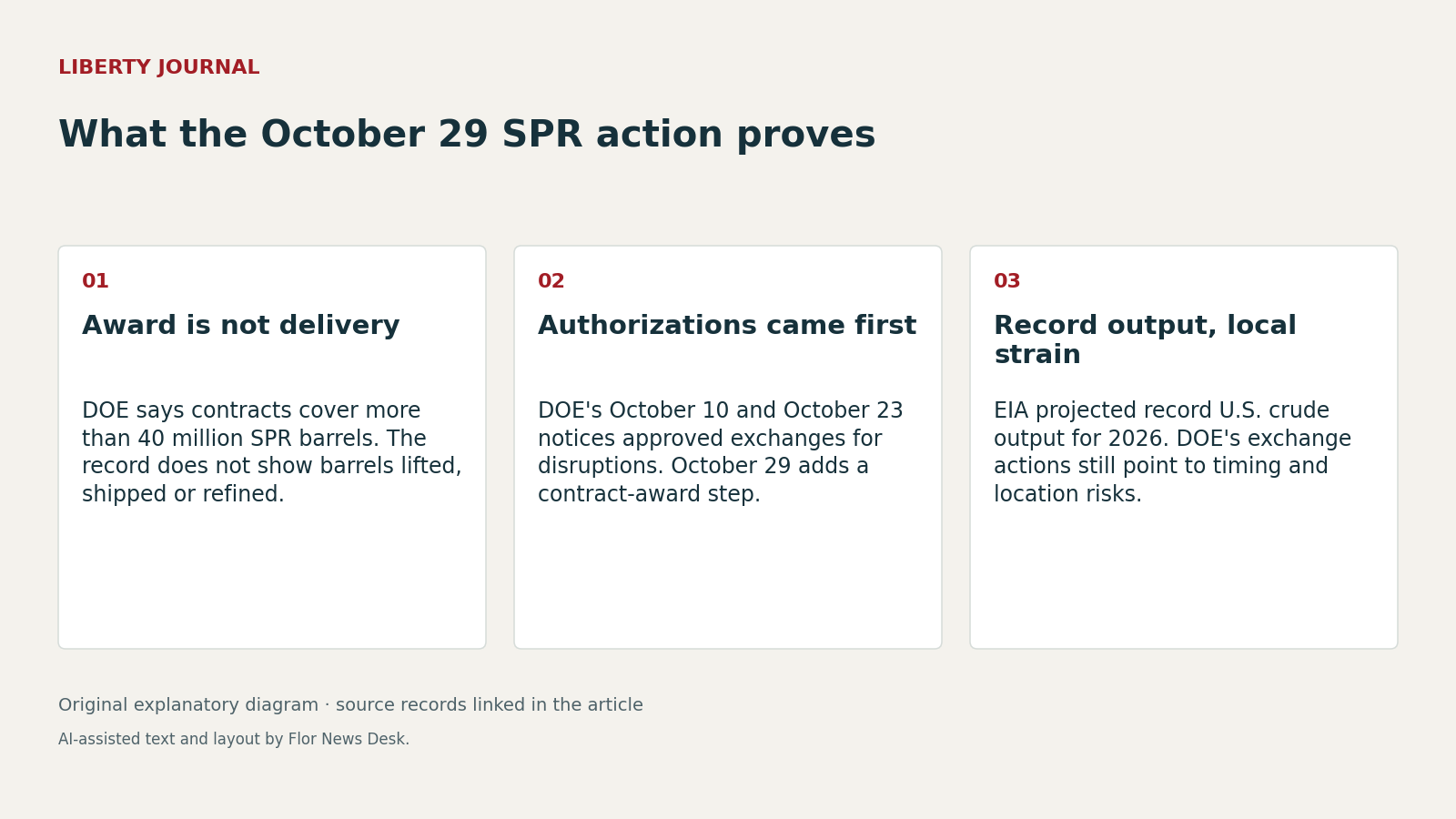
The U.S. Department of Energy said on October 29 that it awarded contracts for an exchange of more than 40 million barrels of crude oil from the Strategic Petroleum Reserve, with supply to come from the Big Hill and Bryan Mound storage sites. DOE’s Office of Petroleum Reserves also said the awards complete its commitment to release 172 million barrels under the administration’s program and form part of a coordinated 400-million-barrel action by International Energy Agency member nations’ strategic reserves. DOE awards release
That matters because a contract award is more than a policy announcement. It suggests counterparties, movement planning and downstream coordination have advanced beyond a general emergency declaration. DOE said it will coordinate movements with awardees and midstream and refining partners, which is a concrete logistics step. But the same record leaves large gaps: DOE did not identify the awardees, publish schedules or prices, or show that barrels have been lifted, delivered, refined or returned. It also said more than 216 million barrels had been arranged to return to the reserve beginning early next year, including 44 million premium barrels, but that remains a forward-looking DOE statement as of October 31, 2026, not a documented result. DOE awards release
The distinction is easier to see against DOE’s earlier October actions. On October 10, DOE said it authorized an emergency exchange of up to 4 million barrels because of inclement-weather-related supply disruptions in the Gulf of America, including up to 2 million barrels each for ExxonMobil and BP America, with returns planned in 2027. That page recorded permission and intended terms, not final contract execution or actual deliveries. DOE October 10 authorization
DOE took a similar step on October 23, authorizing up to 400,000 barrels from the West Hackberry SPR site for immediate delivery to address a crude supply disruption affecting the Phillips 66 Lake Charles Refinery in Louisiana. Again, the public record described purpose and location, not a completed exchange or measured effect on fuel supply. October 29 therefore looks less like a fresh emergency theory and more like an execution milestone inside a broader SPR drawdown program. DOE October 23 authorization
The market context complicates any quick political takeaway. The available EIA record here is a September 10 analysis based on the September 2026 Short-Term Energy Outlook, not a later October update. EIA said U.S. crude oil production was on track to average a record 13.8 million barrels per day in 2026, above the 13.7 million b/d record in 2025. It also projected 6.8 million b/d from the Permian in 2026 and said Federal Gulf of America production in the first half of 2026 ran 10% above the first half of 2025. EIA Today in Energy
The analytical point is that record national output and emergency SPR use are not mutually exclusive. A large production base strengthens U.S. energy security, but an SPR exchange addresses timing and location when a refinery or coastal supply chain is disrupted. National production forecasts do not by themselves prove that a specific plant can obtain the right crude at the right moment. That is a practical argument for keeping emergency infrastructure credible even in a high-output era. EIA Today in Energy DOE October 10 authorization DOE October 23 authorization
For Liberty Journal readers, the conservative case for skepticism is straightforward. DOE has now documented a real procurement step, not just a press strategy. Yet the current record still cannot establish how quickly crude will move, which firms won the awards, what the transaction prices were, whether premium-barrel returns will arrive on DOE’s timetable, or whether motorists will see measurable relief. On those questions, October 29 is evidence of federal execution, not proof of market success. DOE awards release