
The Department of Energy recorded a concrete federal approval step for Port Arthur LNG on September 30, 2026: DOE’s Hydrocarbons and Geothermal Energy Office docket page for Docket No. 26-50-LNG lists Order No. 5490 as granting blanket authority to export previously imported liquefied natural gas from the Port Arthur LNG Terminal in Jefferson County, Texas, to both Free Trade Agreement and non-Free Trade Agreement nations. DOE republished that same order in its 2026 authorizations list on October 14, 2026. DOE docket page 2026 DOE orders list
For readers tracking U.S. export capacity, the significance is specific, not sweeping. DOE’s records show that Port Arthur LNG moved from application to a listed order in this docket. The docket page says the company filed on May 5, 2026, seeking blanket authority to export previously imported LNG up to the equivalent of 20 billion cubic feet of natural gas over two years, and it lists a Federal Register notice published on June 4, 2026, with comments due July 6, 2026. That sequence matters because it documents a completed administrative step rather than a general policy promise. DOE docket page
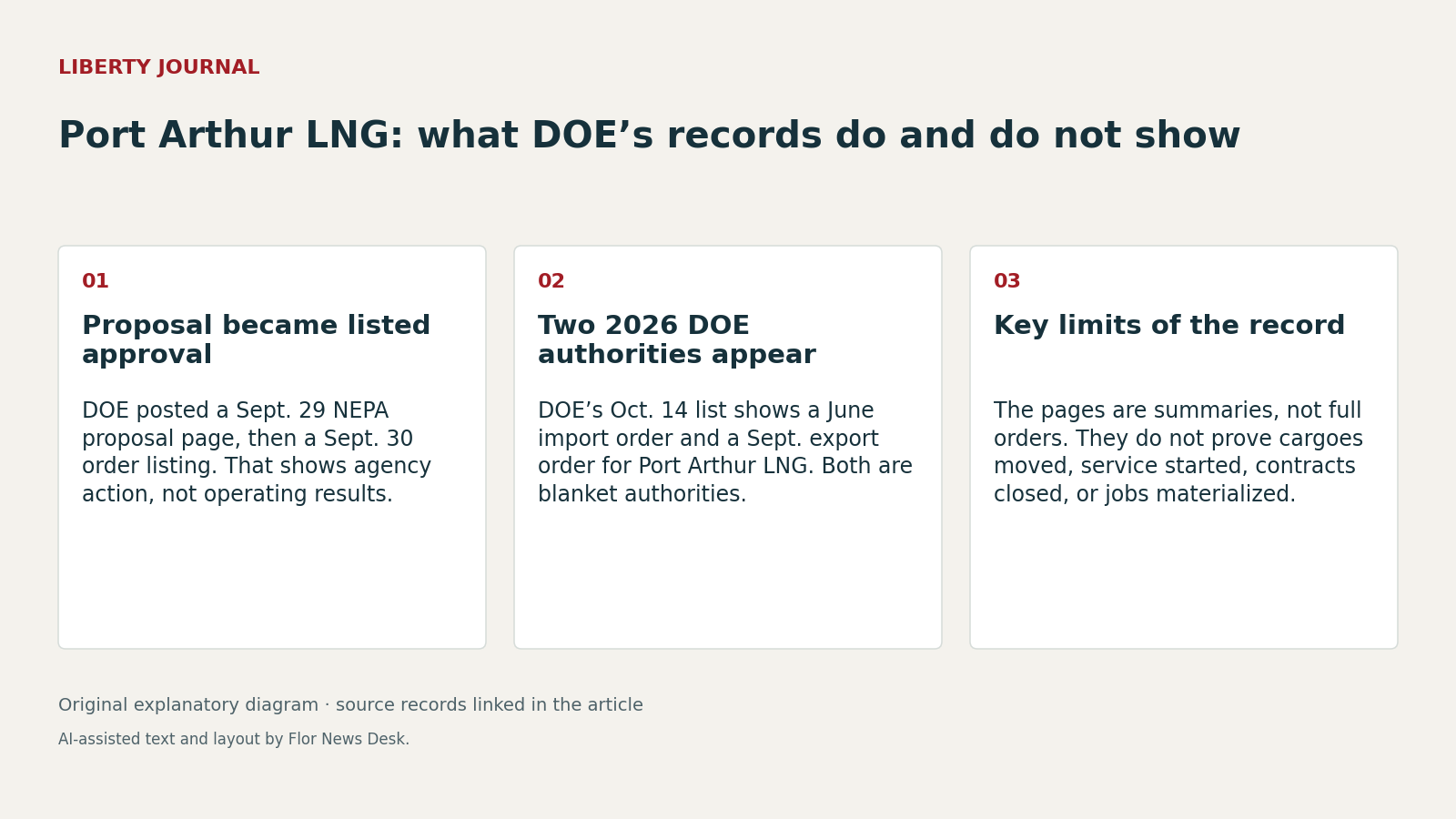
The best way to read the late-September records is as a proposal-to-approval progression, not as evidence of operations. DOE’s Office of NEPA Policy and Compliance posted CX-271097 on September 29, 2026, describing DOE’s proposed action as authorizing short-term exports of previously imported LNG from the same terminal, in the same 20 Bcf amount over two years, if DOE found the exports consistent with the public interest. One day later, the DOE docket page listed the signed order. As analysis, that is the key distinction: a NEPA page can show what an agency is considering, while a later order listing shows DOE says it acted. NEPA categorical exclusion page DOE docket page
A second DOE record strengthens the point that this is more than a one-off website update. The October 14 list also includes Order No. 5434 in Docket No. 26-47-LNG, issued June 15, 2026, which DOE describes as blanket authorization for Port Arthur LNG to import LNG from various international sources by vessel. Together, the June import order and the September export order show DOE has recorded both inbound and outbound blanket authorities for this company in 2026. For a pro-growth energy audience, that is meaningful because fewer missing federal authorizations generally mean less administrative uncertainty than an unresolved application file. 2026 DOE orders list
But the records also impose real limits on what can honestly be claimed. These pages are summaries, not the full text of Order No. 5490 or Order No. 5434. They do not disclose all terms and conditions. They do not establish that the terminal is operating, that cargoes have been imported or exported, that contracts were executed, or that any jobs or revenue have already materialized. The September 30 docket page also contains stale future-tense wording about milestones that, as of October 16, 2026, are already in the past; that wording cannot prove either completion or delay. DOE docket page 2026 DOE orders list
That narrower reading still leaves a useful takeaway. Washington often produces speeches, concepts and litigation without a clear on-paper change for energy projects. Here, DOE’s own late-September and mid-October records document an actual federal authorization step for a Texas LNG project. Supporters of American energy growth can fairly view that as progress in the approval chain. They cannot, on this record alone, treat it as a measured increase in U.S. exports or as proof that Port Arthur LNG has begun commercial service. NEPA categorical exclusion page DOE docket page 2026 DOE orders list