
Canada's federal privacy regulator set out proposals for modernizing the Privacy Act in an August 5, 2026 submission, announced publicly the next day. The August 6 announcement discusses public-sector safeguards, breach obligations and transparency around automated systems. The records describe a reform consultation; they do not announce that Parliament has enacted the requested changes.
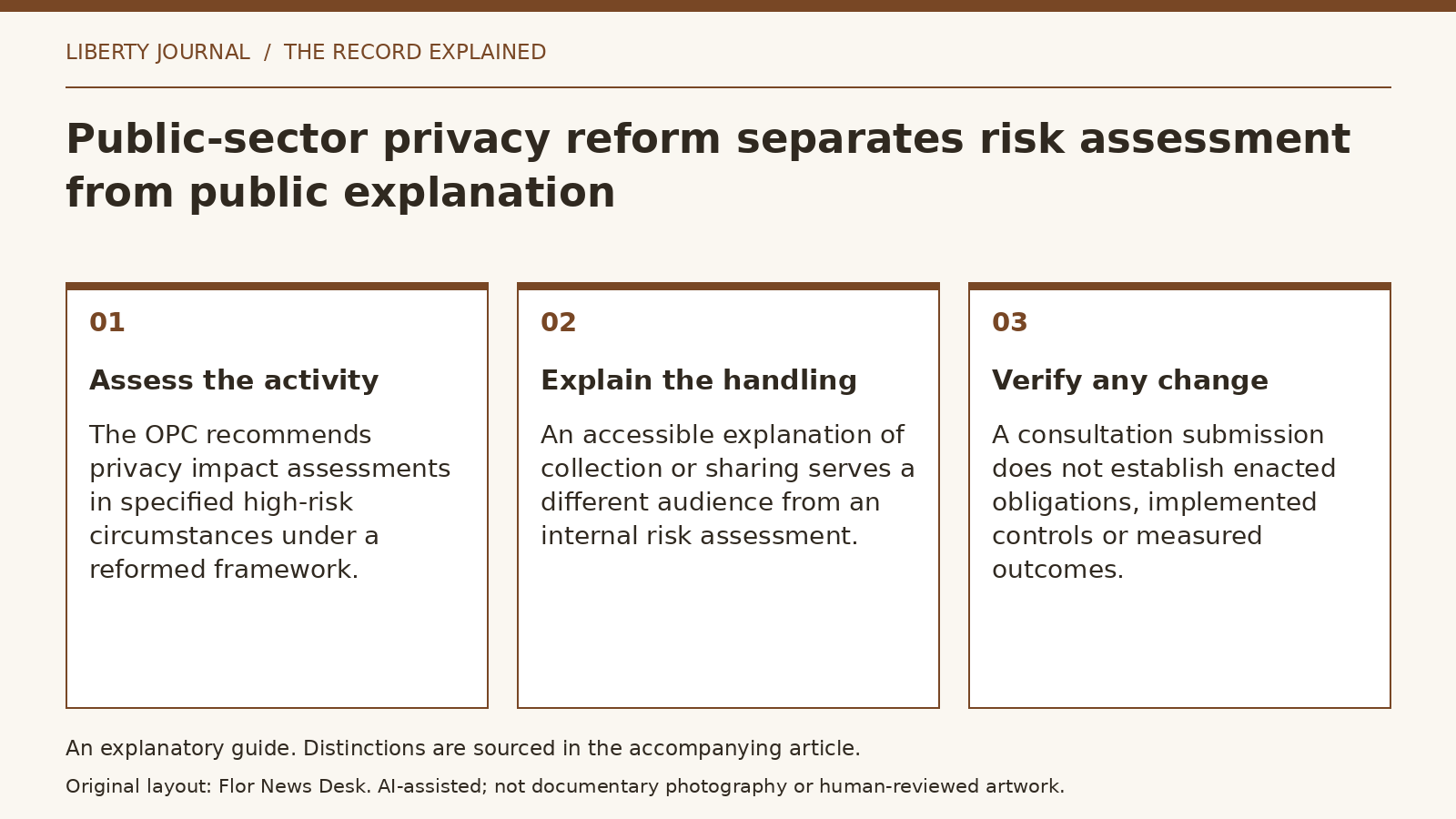
Two ideas in this discussion can sound similar while addressing different audiences. A risk assessment examines an activity and its possible privacy consequences. A public explanation tells someone outside that assessment process what an institution is doing with information. The existence of one document does not establish the usefulness or completeness of the other.
Imagine a hypothetical public service that uses personal information to route applications. Its team could produce an internal assessment of data sensitivity, access and possible errors. An applicant might instead need to understand why their information was collected, whether it was shared and how a record could be corrected. These questions overlap, but an internal document being completed would not demonstrate that an applicant received an intelligible answer.
Which record answers which question?
The OPC's full submission recommends statutory privacy impact assessments in specified high-risk circumstances, including high-impact artificial intelligence and activities involving sensitive information. In its discussion of integrated services, it separately recommends accessible explanations of collection, reuse, sharing and disclosure. The office also seeks more clearly defined authority and purposes for information sharing. These are attributed proposals for a legislative framework.
The hypothetical service shows why an assessment and a notice cannot be counted as the same output. A detailed internal analysis could contain technical material that does not explain an individual's interaction with the service. A short, comprehensible notice could explain that interaction while leaving an investigator unable to evaluate the institution's full assessment. Each document would need to be examined against the question it is supposed to answer.
There is a further distinction between identifying a risk and demonstrating a change in practice. Recording that an error could occur is an assessment result. Showing that a control was introduced is implementation evidence. Measuring whether that control affected errors would require another kind of observation. None of those stages follows merely from the word assessment appearing in a project description.
The submission's emphasis on information sharing also raises a question of scope rather than a simple count of connected services. In a fictional integrated system, two institutions could share one field or an entire application. Both arrangements might be described as integration, yet the information involved would differ. That is why a general label cannot establish what an actual arrangement permits or does.
The announcement and submission are two OPC records, not independent evaluations of a deployed government system. They contain no measured outcome for the hypothetical service and do not establish that future legislative language will match the commissioner's recommendations. The August 5 submission date and August 6 announcement date identify different events, not two separate reforms.
Reading the consultation through these distinctions keeps the proposed architecture visible: assessment, explanation, authority and implementation evidence are related but separate. A later bill, regulation or operational report would have to show what changed in its own terms. The consultation alone cannot supply that later result.