
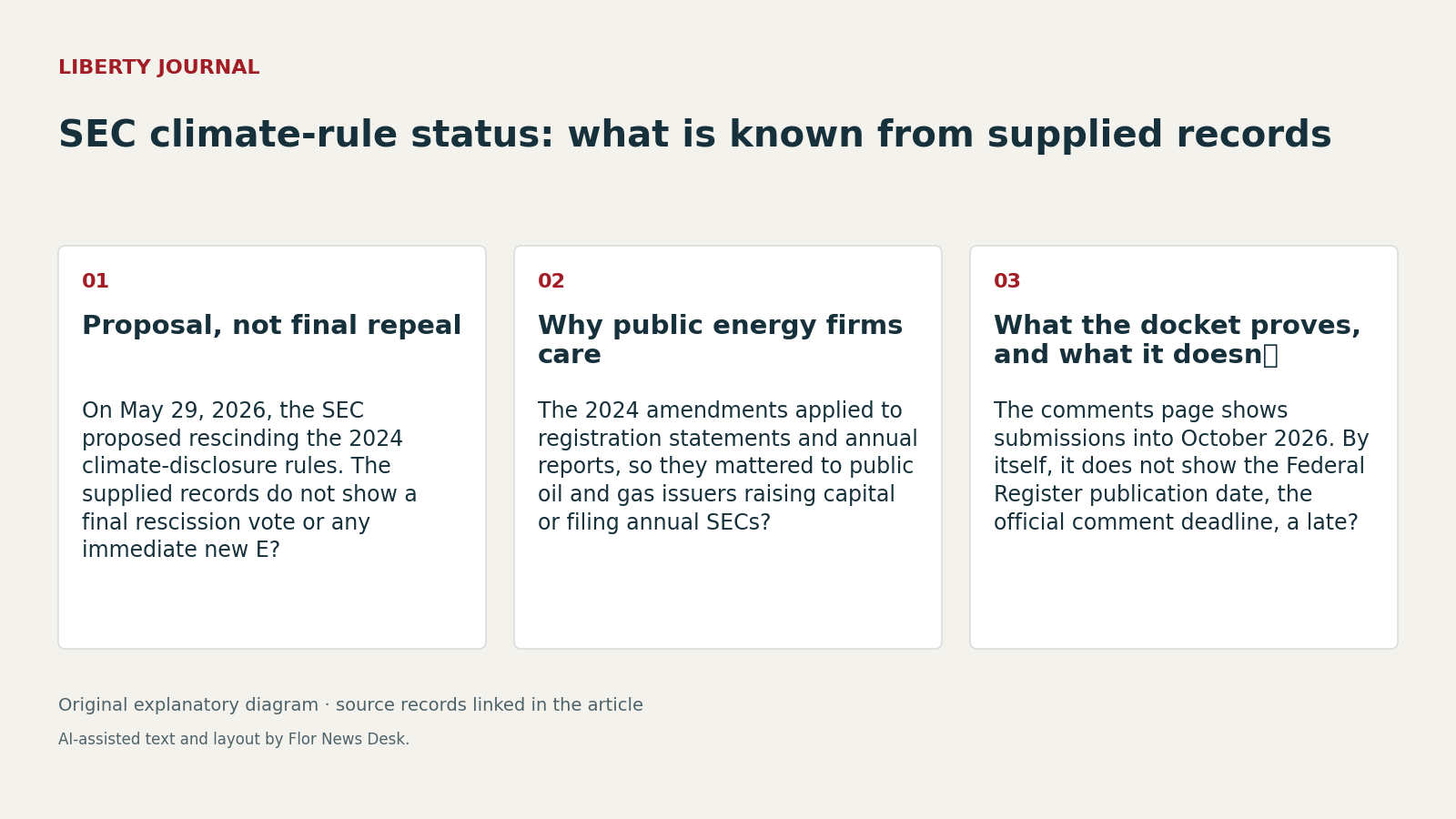
The Securities and Exchange Commission said on May 29, 2026 that it proposed rescinding the climate-related disclosure rules it adopted in March 2024, a federal action with clear relevance for publicly traded U.S. energy companies because those amendments applied to registration statements and annual reports under the main federal securities laws. The same SEC release says the agency had already stayed those rules on April 4, 2024 pending litigation, so the May 2026 move is best understood as a formal notice-and-comment repeal effort, not proof that the rules have already been wiped away. SEC press release, May 29, 2026 SEC press release, March 27, 2025
That timeline matters. The SEC said on March 27, 2025 that it voted to end its defense of the 2024 rule in the Eighth Circuit litigation, *Iowa v. SEC*, and notified the court that Commission counsel would no longer advance the agency’s prior arguments. The SEC’s May 29, 2026 release adds that the Eighth Circuit on September 12, 2025 held the consolidated petitions in abeyance while the Commission either reconsidered the rules through notice-and-comment rulemaking or renewed its defense. That does not establish a court ruling on the merits. It does show that the Commission chose rulemaking, rather than continued litigation, as its route for trying to unwind the 2024 package. SEC press release, March 27, 2025 SEC press release, May 29, 2026
For oil and gas issuers, the practical policy question is what disclosure standard would govern if rescission is finalized. In a May 29, 2026 statement, Commissioner Mark T. Uyeda argued that the SEC should stay anchored to financial materiality and that climate-related matters can already be addressed through existing disclosure categories when material. That is a significant distinction for public producers, midstream operators and refiners: a rescission would mean the SEC is trying to pull back from a stand-alone climate-specific regime and return to a more traditional materiality-based framework. The supplied record, however, does not prove realized compliance savings, cheaper financing or changed lending terms for energy companies. Uyeda statement, May 29, 2026 SEC press release, May 29, 2026
What the record does not show is just as important. The SEC comments page for File No. S7-2026-19 displayed a large stream of submissions at retrieval, including visible entries dated October 27, 2026 and October 5, 2026. But that docket page, by itself, does not provide the Federal Register publication date, does not establish the official close of comments, and does not show any final Commission vote adopting rescission. As of November 1, 2026, based on the supplied records, readers should not confuse an active docket with a completed repeal or with a demonstrated current change in reporting duties. SEC comments docket SEC press release, May 29, 2026
The economic backdrop helps explain why this matters beyond securities lawyers. The Federal Reserve’s October 2026 Beige Book, based on information collected on or before October 5, 2026 and updated October 14, 2026, said higher oil prices permeated all District reports and that firms reported elevated diesel prices and fuel surcharges moving through supply chains. It also said several Districts cited persistent uncertainty around energy and tariffs. That does not show any causal effect from the SEC proposal. It does show that energy conditions remained economically important while Washington reconsidered whether public companies should face a climate-specific federal disclosure regime. Federal Reserve Beige Book, October 2026 national summary
For Liberty Journal readers, the supported bottom line is narrower than either side’s rhetoric. The SEC is actively trying to rescind the 2024 climate-disclosure rules, a move that could ultimately lighten a specialized reporting burden for public oil and gas companies. But the supplied record still does not show a final repeal, a court merits resolution, or measurable market effects. Those remain open questions, not established outcomes.