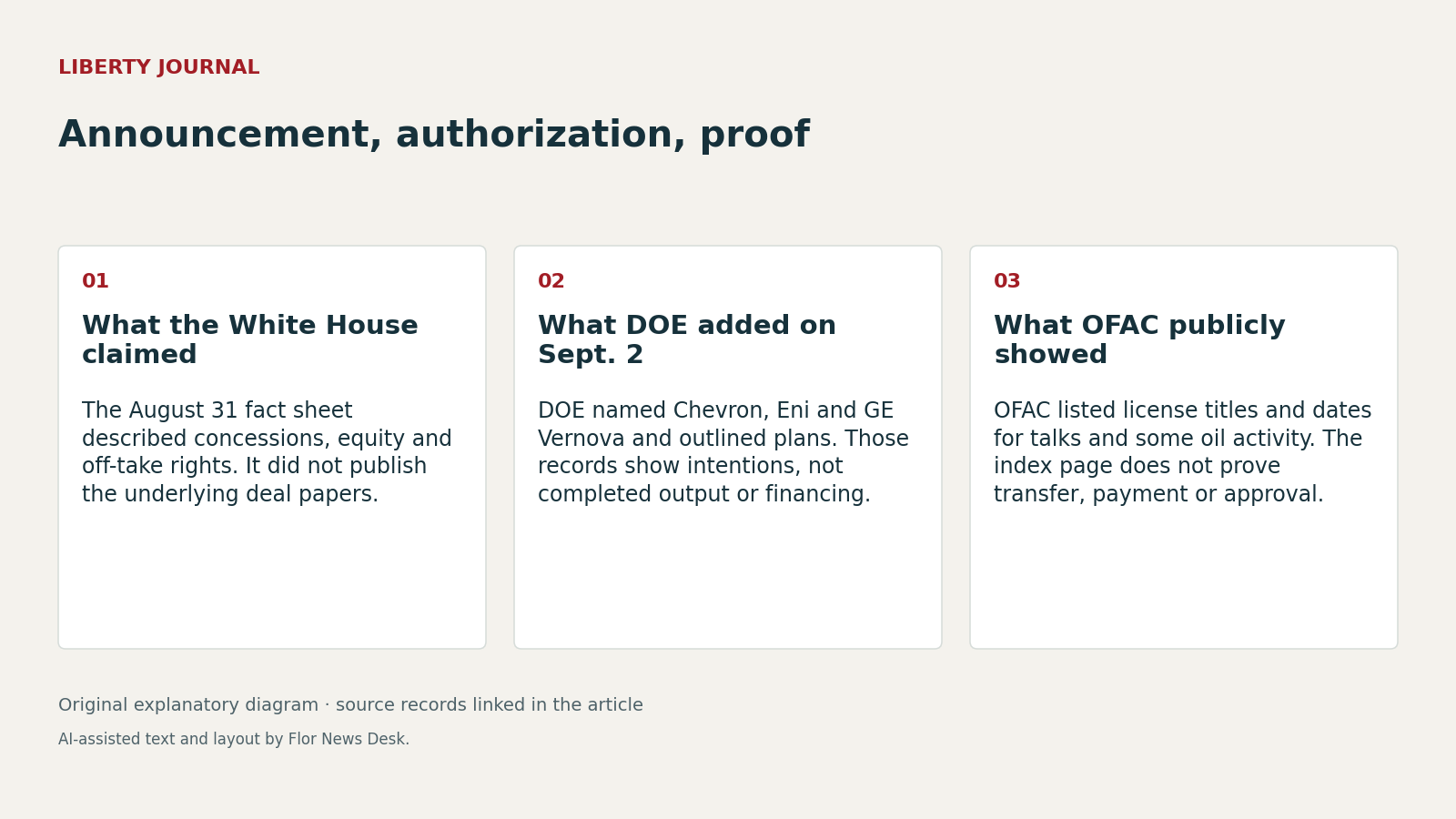
The White House said on August 31, 2026 that the United States had secured majority control of more than 65 billion barrels of proved Venezuelan oil reserves, describing 17 field concessions, a 35% equity stake for a U.S. government office, and preferential off-take rights for the U.S. government in a fact sheet about Venezuela policy. That is a significant energy-security claim, but the same public record does not include the signed agreements, concession registrations, equity-transfer documents, or payment records that would let outside readers test whether control has moved from announcement to enforceable reality. White House fact sheet
The Department of Energy added commercial detail on September 2, 2026. DOE said Secretary Wright traveled to Venezuela and oversaw energy agreements involving Chevron, Eni, and GE Vernova; it also presented forward-looking plans, including Chevron’s stated intent to invest more than $7 billion over five years and lift output to 600,000 barrels per day, plus Eni’s Junín 5 contract and GE Vernova grid additions. Those points matter because they move the story from a geopolitical headline toward named corporate projects. They still remain plans or agency-described agreements in the public record provided here, not demonstrated production gains, closed financing, or completed infrastructure. DOE fact sheet
Treasury’s Office of Foreign Assets Control then supplied the clearest sign that Washington was adjusting the sanctions framework, but not the proof of consummated control. On its Venezuela sanctions page, OFAC lists amended general licenses dated September 28, 2026, including General License 49B on negotiations and contingent contracts for certain investment in Venezuela, General License 46E on certain activities involving Venezuelan-origin oil or petrochemical products, and General License 48D on certain supplies and services. The page also lists General License 50C on certain oil or gas sector operations and General License 52C on certain transactions involving Petróleos de Venezuela, S.A. OFAC Venezuela sanctions page
That is an important legal distinction. A general license can authorize categories of conduct without requiring each U.S. person to seek a specific license, according to OFAC’s own index page. But the index page alone does not show the operative terms, covered entities, exclusions, conditions, or expiration dates of those licenses. So the public material retrieved here supports a narrower conclusion than the political rollout suggests: Washington created or amended permissions consistent with negotiations, contingent contracting, and some oil-sector activity, yet those steps are not the same thing as proving that equity changed hands, that Venezuelan approvals were completed, or that crude is already flowing under the announced terms. OFAC Venezuela sanctions page
For a pro-growth and energy-security audience, that gap is the real story. If the administration’s objective is to expand supply and strengthen U.S. leverage in the hemisphere, the relevant benchmark is not whether an announcement was large. It is whether the announced rights survive the contract, sanctions, and host-country approval process. Based on these records, the federal government has shown a policy direction and a sanctions opening. It has not publicly shown the underlying documents needed to verify majority control of reserves, the mechanics of any Strategic Petroleum Reserve off-take arrangement, or realized barrels, revenue, and power generation. White House fact sheet DOE fact sheet
The practical takeaway is restrained but still meaningful. As of October 2, 2026, the available federal record supports saying the administration announced a major Venezuela energy initiative and Treasury listed related sanctions authorizations by title and date. It does not yet support saying the United States has publicly demonstrated completed control, completed investment, or completed production increases. For readers trying to separate energy opportunity from political theater, that distinction is not caution for its own sake. It is the line between a potential supply story and a documented one.