
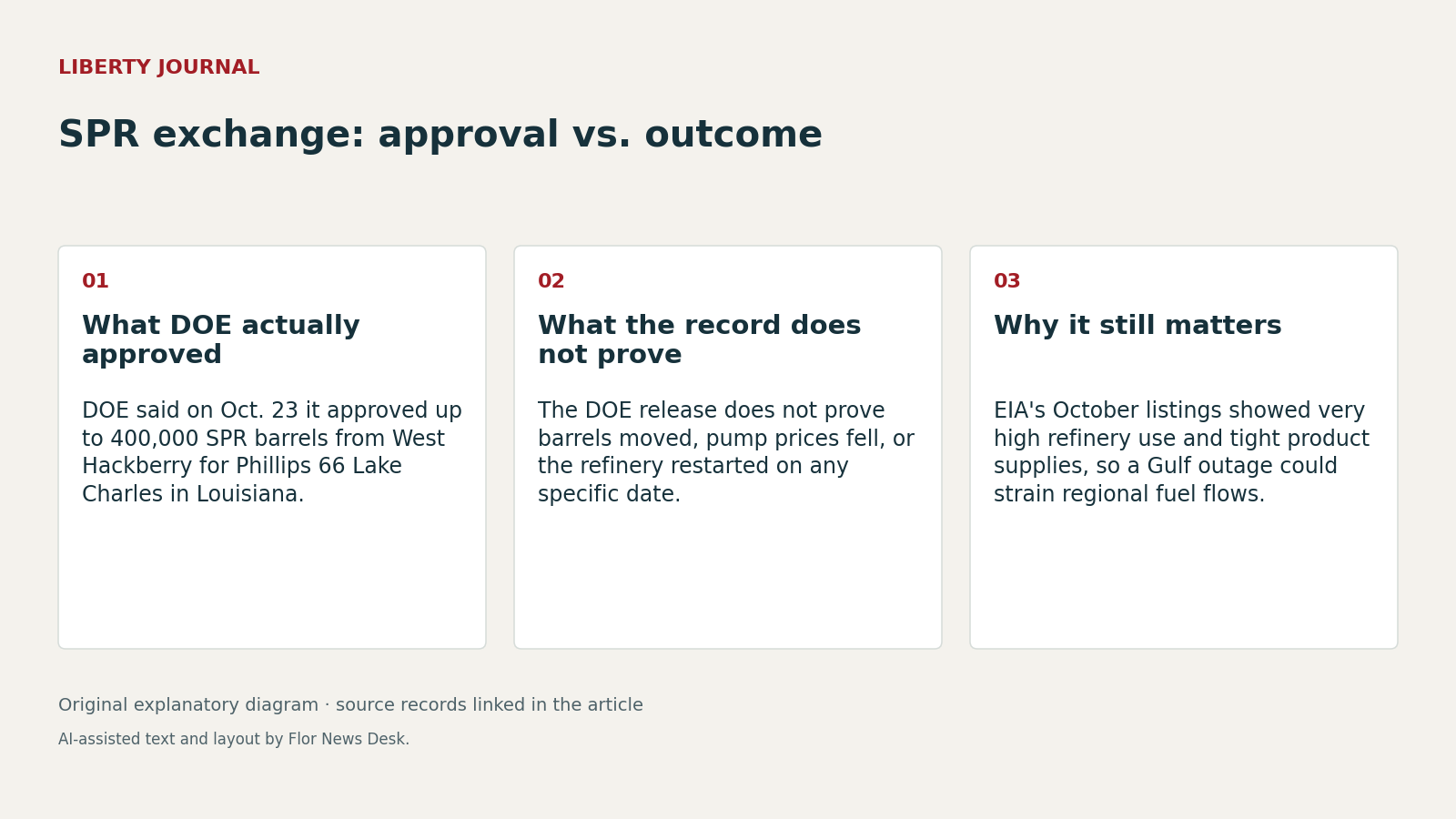
The U.S. Department of Energy said on October 23, 2026 that it authorized an emergency Strategic Petroleum Reserve exchange of up to 400,000 barrels of crude oil to address a supply disruption affecting the Phillips 66 Lake Charles Refinery in Louisiana. DOE said the barrels would come from the West Hackberry SPR site, could be delivered immediately to the refinery, and must be returned to the reserve with additional premium barrels. That is a concrete federal action. It is not, on this record, proof that any barrels were delivered, when they moved, or whether motorists saw price relief. DOE October 23 authorization
The significance is operational, not symbolic. EIA’s October public listings said U.S. refinery utilization averaged more than 95% of capacity from May through September 2026, the highest for those months since 1998, and also pointed to tight global product supplies and strong petroleum-product margins, especially for diesel. Those facts do not establish a shortage at Lake Charles or in any specific city. They do help explain why DOE described the exchange as support for fuel availability in Louisiana and the surrounding region: when refineries are already running hard, even a localized feedstock disruption can matter more than it would in a looser market. EIA Today in Energy homepage DOE October 23 authorization
This October 23 move was also different from DOE’s larger October 10 emergency exchange. In that earlier action, DOE said it authorized up to 4 million barrels for ExxonMobil and BP America because of supply disruptions tied to hurricane-related Gulf weather, including faster delivery of previously awarded SPR crude, with repayment and premium barrels due in 2027. The new authorization is narrower and more targeted: one refinery, one Louisiana disruption, one named SPR site, and a ceiling of 400,000 barrels. That distinction matters because it shows DOE using the SPR as a short-term logistics bridge rather than announcing a broad market intervention. DOE October 10 authorization DOE October 23 authorization
For conservatives, the policy lesson is mixed but clear. An emergency exchange can be a practical way to keep crude moving into a refinery during a disruption without claiming that a one-off federal action has solved a larger supply problem. At the same time, the record underscores what SPR exchanges cannot do. They do not repair refinery equipment, expand pipeline capacity, add permanent refining investment, or prove lower household fuel bills. Those outcomes would depend on later operational data and market evidence that do not appear in these documents. DOE October 23 authorization DOE October 10 authorization
The public DOE paper trail, at least in the retrieved records, is thinner than readers may expect. DOE’s Hydrocarbons and Geothermal Energy Office page titled “Listing of DOE Authorizations/Orders/Notices Issued in 2026” appeared, in the retrieved text, to list natural gas and LNG matters such as Order 5512 for AAA Energy Services, not a Phillips 66 SPR exchange. A separate “2026 Orders” file list showed filenames, including a natural-gas PDF, but did not itself summarize an SPR order for this refinery-specific action. Those pages do not negate DOE’s October 23 announcement, but they also do not independently establish the exchange terms or execution. 2026 authorizations index 2026 orders file list
As of October 29, 2026, the most defensible reading is narrow. DOE announced a targeted emergency exchange meant to help one Gulf Coast refinery keep crude supply moving and support regional fuel availability. EIA’s October listings suggest that this happened in a period of unusually high refinery use and tight product markets. The broader free-enterprise case is that emergency federal barrels are, at best, a bridge. Durable energy security still depends on strong domestic production, resilient refining, and a policy climate that makes private investment easier before the next disruption arrives. DOE October 23 authorization EIA Today in Energy homepage