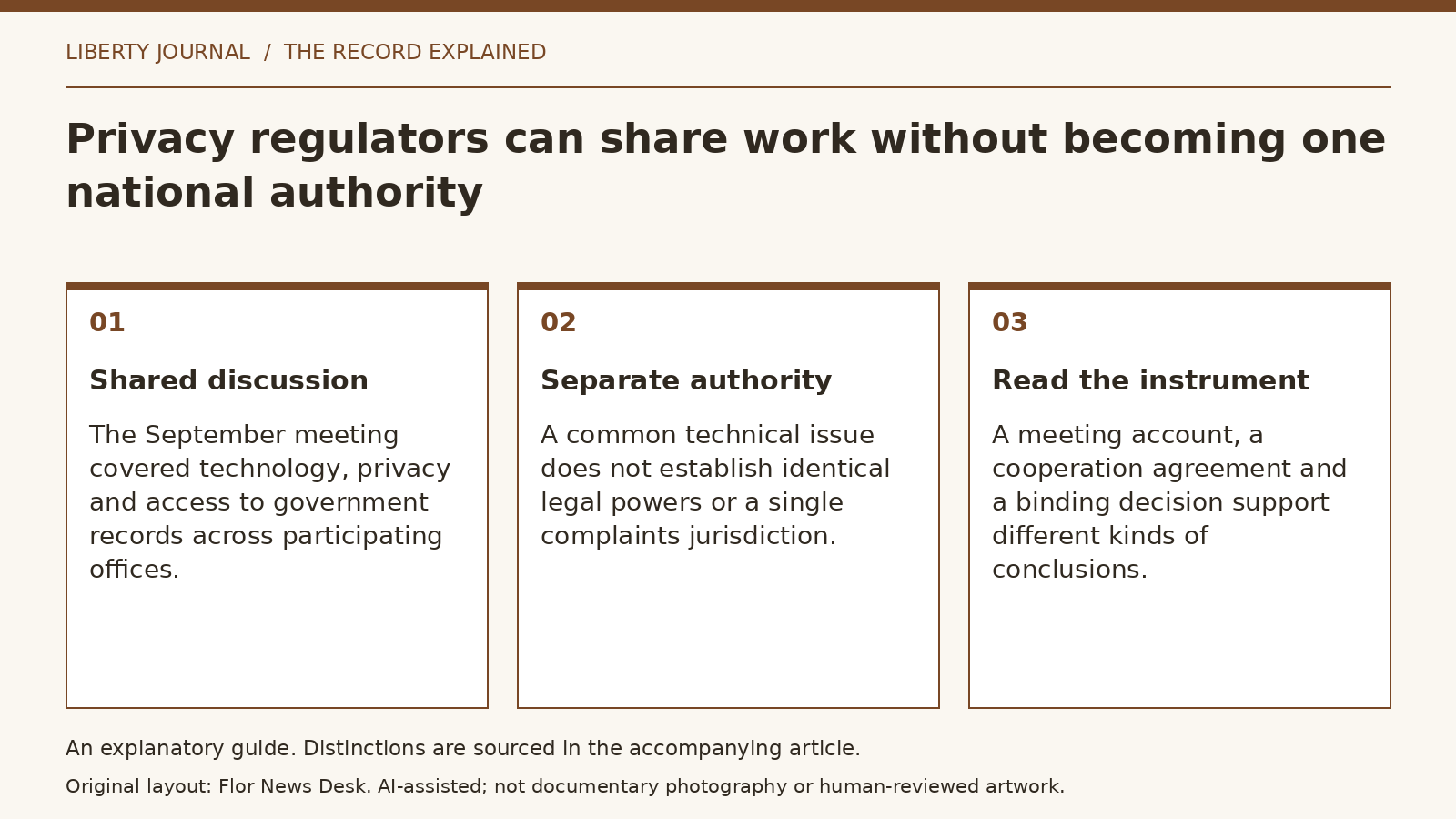

Canadian privacy and information oversight bodies met in Ottawa in September to discuss technology, data and access to government records. The federal privacy commissioner's September 16, 2026 account describes participation by federal, provincial and territorial commissioners and ombuds offices. It records a shared discussion, not the creation of a single national regulator.
The distinction is relevant to anyone reading a joint meeting as a change in who can investigate a complaint. Agreement that an issue deserves attention does not itself move a file from one legal jurisdiction to another. Nor does an exchange of expertise demonstrate that participating offices have acquired identical powers. Those are separate propositions requiring different evidence.
The meeting's topics included artificial intelligence, quantum technology, cross-border data flows and digital sovereignty. Its access-to-information discussions also addressed the creation and management of government records. According to the announcement, participants heard from people across government, academia, industry, civil society and the legal community. The account does not announce new legislation or a replacement complaints system.
A shared subject is not a shared case
A hypothetical technology service illustrates why subject-matter overlap and jurisdiction should not be collapsed. Suppose a provincial institution and a separate private business use a similar software product. A common technical question could interest more than one oversight body. That similarity alone would not establish that the organizations have the same legal obligations or that the same office can issue every relevant remedy.
This example is not a jurisdictional determination about a real service. It shows the missing step in an inference: knowing that two organizations use comparable technology does not identify the legal regime governing each use. Collaboration may help offices understand a technical issue while leaving that legal allocation unchanged.
The OPC's background page on provincial and territorial collaboration describes a federal oversight role alongside provincial and territorial offices. It notes that some provinces have private-sector privacy legislation recognized as substantially similar to PIPEDA, and describes cooperation through activities and agreements. The page supplies institutional background, not a September 2026 announcement of newly transferred powers.
There is another distinction inside the meeting's agenda. Access to a government record and protection of personal information can concern the same document, but they ask different initial questions. One asks about obtaining information held by an institution; the other asks about the handling of personal information. Naming both topics in a meeting does not establish how a particular disclosure dispute should be decided.
For interpreting future announcements, the type of instrument matters. A meeting account can show what was discussed. An agreement can state arrangements among the parties that sign it. A statute or decision may establish powers or determine a dispute within its scope. Substituting the first kind of record for the last would overstate what the evidence shows.
The September announcement and the older institutional page are both OPC publications, so they are not independent assessments of whether cooperation improved outcomes. They establish a network of oversight bodies discussing common questions. They do not establish a unified jurisdiction, a changed complaint route or an outcome for any individual case.