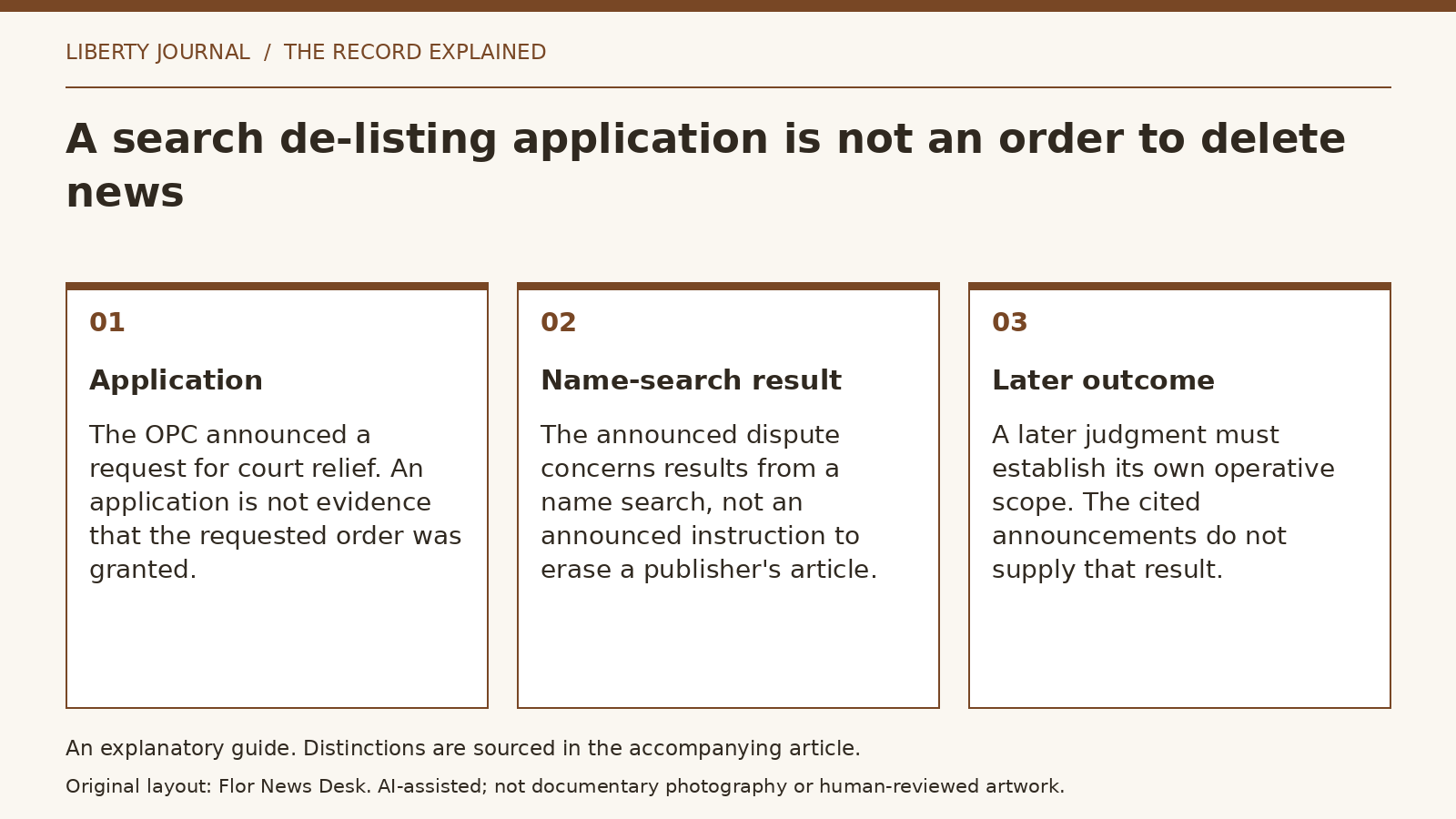

Canada's privacy regulator announced on August 28, 2026 that it had applied to the Federal Court to pursue recommendations arising from its investigation of Google search results. The OPC's announcement concerns de-listing particular results returned by a search for an individual's name. It does not announce an order requiring a publisher to erase an article.
There are two distinctions in that sentence. The first is procedural: a court application requests a result rather than establishing that the court has granted it. The second concerns the object of the requested action: a search result and the material it points to are not the same publication surface. Losing sight of either distinction changes the apparent reach of the dispute.
The OPC says its August 2025 investigation found that Google's continued display of the results in this context contravened PIPEDA. That is the commissioner's finding, not a newly reported court judgment on the requested remedy. The office explains that it cannot issue binding PIPEDA orders and must seek relief in court. This article does not establish any later disposition of the application.
Follow the query, not just the link
Consider a hypothetical article that can be found through a person's name, a subject search and a direct address. Removing its result for the first query would change one route to the material. It would not logically demonstrate that the other routes had disappeared. Whether any real order affects additional routes depends on its actual wording; the example does not predict what the court will decide.
That technical distinction also limits claims about public access. A change in one search pathway could alter discoverability without deleting the source. Conversely, the source remaining online would not mean that discovery through the affected pathway was unchanged. Availability and discoverability describe different observations, so neither should be used as a substitute for the other.
The OPC's case chronology published in August 2025 places the dispute in a longer sequence beginning with a 2017 complaint. It records earlier litigation over whether PIPEDA applied to Google's search activity, including a 2021 Federal Court ruling and a 2023 appeal decision. Those procedural stages should not be mistaken for a decision on every later request made in the complaint.
A chronology can therefore be read as a sequence of questions, not simply a count of victories or defeats. A jurisdictional ruling asks whether a legal framework can apply. An investigation evaluates conduct within its remit. A subsequent application asks a court for specified relief. A statement about one stage does not automatically establish the answer at another.
The two linked accounts are both published by the OPC. They document the regulator's description and position, not an independent presentation of every party's submissions. They also do not provide an observed measure of how readers found the underlying material before or after any action.
The precise public account is consequently narrower than a claim that Canada has ordered news deleted: the regulator has described a name-search de-listing dispute and a court application. A later judgment would need to be read for its own reasoning, operative terms and scope, rather than inferred from the announcement that proceedings were started.